About Andy
I am a multi-talented person, although it is hard for me to describe myself as any one kind of maker. I will see something—or think of something—and say to myself, “I could make that.” Then I do.
My skill set is varied because I develop new skills as the need arises. I try not to pigeonhole myself by saying I only make one thing or work in one medium. Curiosity has a way of leading me from one project to another, and following those flights of fancy is an important part of how I work.
I studied oil painting at Murray State University, where I received my BFA and teaching certificate. Many of the fundamentals I learned are still with me, but there is not much in my current work that can be tied directly to what I was making then. In hindsight, the desire and aptitude to explore more were already there. At the time, though, I needed to commit myself to developing a focused body of work.
Watercolor came into my life while I was deployed with the National Guard. My wife and I would have painting nights together over Skype as a way to connect while we were apart. I could not bring oil paints with me, so watercolor became the answer.
I continue to work in watercolor because of its portability and immediacy. I can pack it with me, follow my whims, and make something wherever I happen to be. I love the flow of the paint, the way the colors interact, and a vibrancy that is difficult to imitate in other media. But watercolor is unforgiving. One mistake can be there forever. You either embrace it, or into the bin it goes.
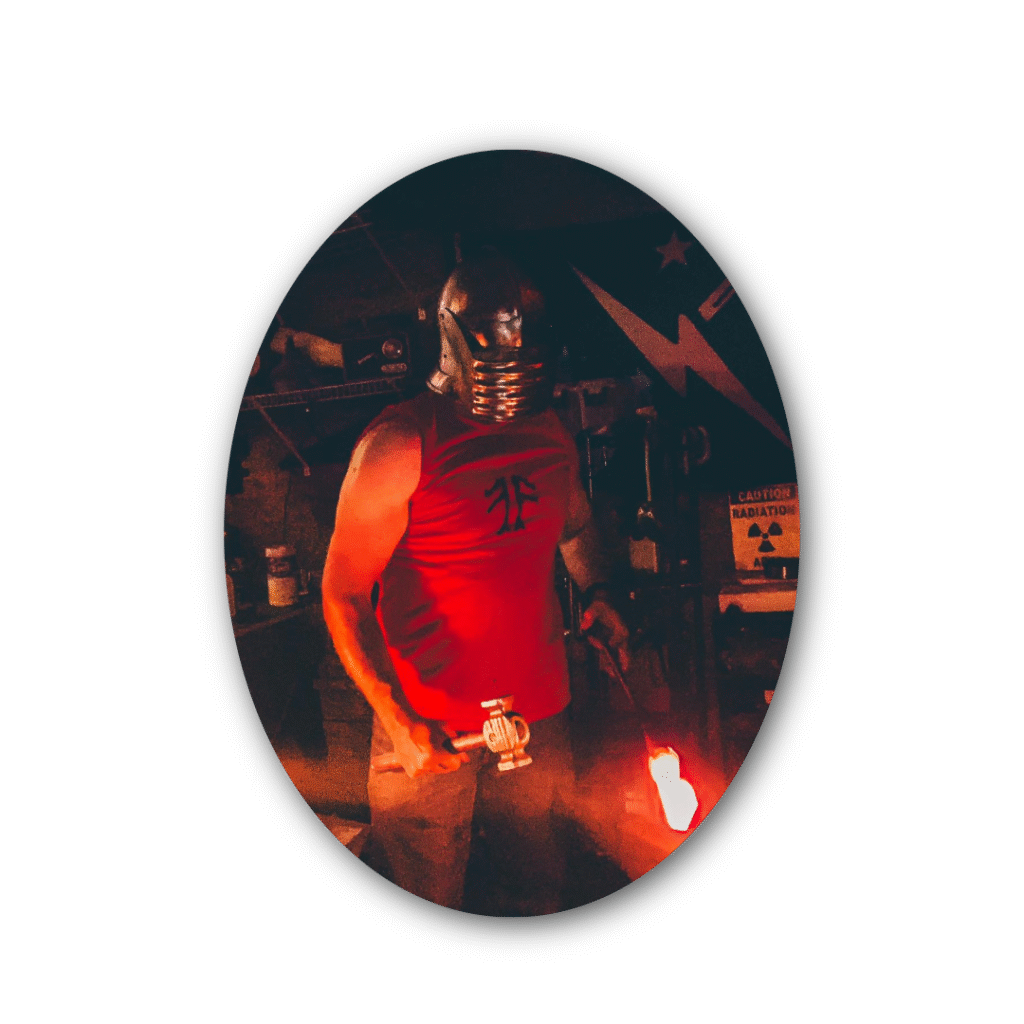
I had always been drawn to blacksmithing. Something about the heat, the metal, and the act of making something enduring spoke to me. Mastering those elements to create something useful or beautiful feels primal. Blacksmithing began as another one of my flights of fancy: I saw someone doing it on television, thought, “I can do that,” enrolled myself in YouTube University, and started making. I have not stopped.
My work includes paintings, landscapes, objects inspired by popular culture, household goods, blades, tools, and historical recreations. The thing connecting all of it is me—but it is also the way human beings navigate their surroundings. The things we carry. The things we see. The things we care about.
An object or a landscape has no meaning until someone experiences it. A landscape matters because we watched the sun set over it, grew up seeing it every day, or tied a memory to it. We watch a show, read a book, or see a movie, and somehow we care about it. We become fans. We connect history to landscapes, objects, and artifacts. Physical things become connections to meaning.
I have a favorite hat. I do not have a particularly good reason to have a favorite hat. It is just an object—but I like it. That simple attachment says something about us. In a world where many of the objects around us feel meaningless, I want to surround myself with things, places, and people that do have meaning. I want to make things that people look at, hold, use, and—for reasons that may be entirely their own—care about.
To me, something that is made well is felt more than it is quantified. You hold it and it feels right. It feels alive. It wants to do its job. It has the right weight and balance. In a mass-produced world, you can pick something up and immediately feel that it is cheap. The balance is wrong. It is too heavy or too light. It feels like it will break as soon as you begin using it.
I wish I had a more precise way to describe good craftsmanship, but sometimes the truth is simply this: you know it when you feel it.
Ultimately, I make every piece as though I might own it myself. I am driven by my whims, thoughts, interests, and desires. Experience has shown me that when I make something I would be proud to possess, other people often feel the same way. My hope is that when someone purchases a piece of my work, they feel that sense of connection—that they have found something made with care, something worth keeping, and something that feels like it belongs to them.
—Andy
Shop available work · Contact me about commissions, classes, or demonstrations