So… cloak ownership seems to be considerably higher at a renaissance fair.
That does make a difference when you’re deciding whether a cloak pin is useful. Somebody who doesn’t own a cloak probably isn’t losing much sleep over how to fasten one. Put that same object in front of people dressed for a faire and the purpose needs considerably less explanation.
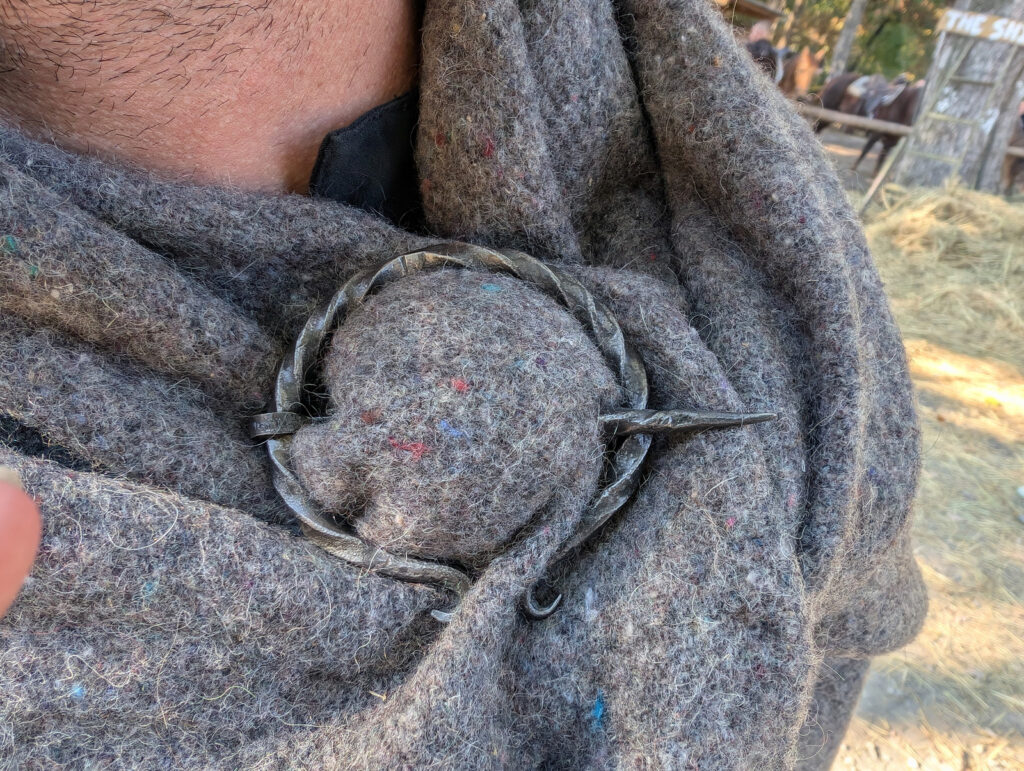
My own version started with an old wool blanket. I was getting ready to attend fairs as a vendor, didn’t know whether the weather would be warm or cool, and figured a cloak would be useful. The blanket would do. Keeping it closed was the part I hadn’t sorted out.
Being a blacksmith made that a fairly straightforward problem to take into the shop. I needed a fastener, so I made one. Then, because making one seemed like a good reason to make eight, I made more.
What interests me is that the finished object can serve a need and be entirely recreational at the same time. Wearing a cloak to a faire is something you choose to do for the fun of it. Once you’re wearing it, though, having a way to keep it closed is a practical concern. The pin still has a job.
That overlap is part of why traditional designs interest me. There’s a useful question behind them: what does this object need to do? The shape has to make sense for that task, even when the setting around it includes costumes and a bit of fantasy.
I like making something that looks at home there and works when somebody actually uses it.
In my case, the immediate requirement was pretty modest. I had a wool blanket, I wanted to wear it, and I wanted it to stay closed. A cloak pin took care of that.