Vending involves more sitting than the finished photographs suggest.
There are busy stretches when people are moving through the booth, asking questions, picking things up, and telling stories. There are also quiet stretches. I could spend those periods looking at my phone, but I would rather keep my hands busy.
So I paint.
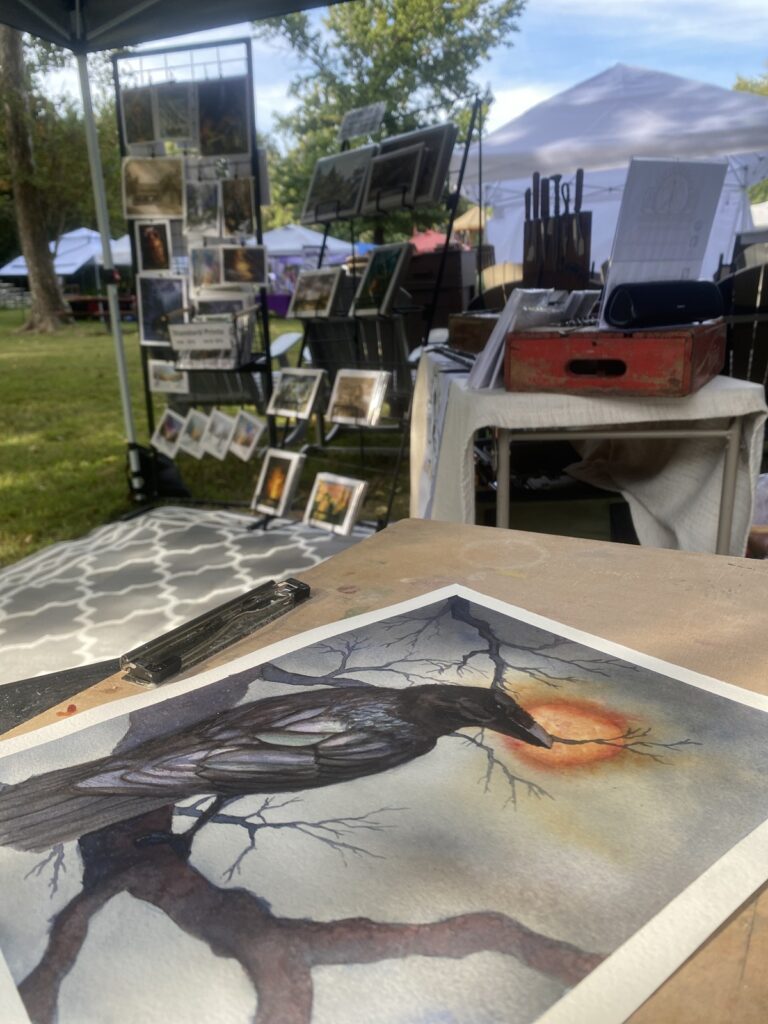
Working at the booth changes the process in useful ways. Interruptions are welcome. At home or in the shop, an interruption can feel like something pulling me away from the work. At an event, the interruption is part of the reason I am there. Someone sees the brush moving, watches the color spread, and asks what I am doing. The unfinished painting gives us somewhere to begin.
People are often more willing to approach a process than a finished object.
A completed painting can look settled. It presents itself as something already decided. A work in progress still contains questions. Viewers can see the loose shapes, the places where paper is showing, and the decisions that have not yet been made. They ask what it will become. Sometimes I know. Often I do not.
When I paint at the booth, I usually do not use a reference. Imagination and the paint decide where it goes.
That is not mystical. Watercolor simply has opinions. It moves, blooms, dries, and leaves edges whether or not those were the exact edges I had in mind. I respond to what is on the page. A dark shape suggests a tree, a tower, a bird, or a piece of landscape. One color pushes me toward another. The image becomes clearer by making the next reasonable decision rather than by following a complete plan.
That approach suits the booth. I can stop when someone wants to talk and return when the conversation ends. The painting does not need to resent the interruption. It can wait, dry a little, and become something slightly different when I come back to it.
Painting in public also lets people see that art is work without making the work look inaccessible. They see the ordinary parts: mixing color, testing a brush, waiting for a wash to dry, deciding that a shape is wrong, and figuring out what can be done about it. The process draws people in because it is active and understandable.
It also gives me something honest to do.
I am not standing behind the table performing enthusiasm at every person who passes. I am making. If someone wants to watch, they can watch. If they want to ask a question, interruptions are welcome. If they simply want to browse, the work continues.
That creates the kind of booth I want: not just a temporary store, but a place where people can meet the work while it is still becoming itself.